
Guides Earthworks takeoff How-to
Soil bulking and shrinkage factors — a working table
Typical swell and shrink factors for clay, sand, gravel, topsoil and rock, and how to apply them to cut, fill and cartage.
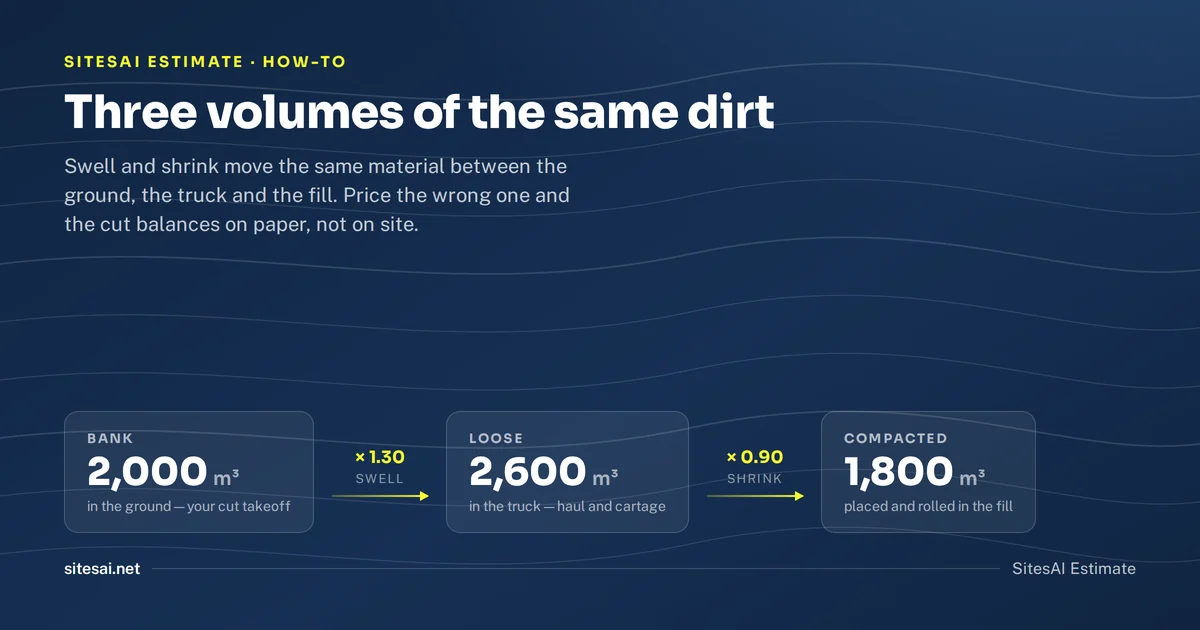
Every earthworks estimate quietly converts between three volumes of the same dirt. Get the conversion wrong and the cut balances on paper, the trucks do not, and you find out when the import bill arrives.
This page gives a working table, shows where each factor goes in the estimate, and says when to stop trusting a table and ask for a test.
Three volumes of the same dirt
- Bank volume — the ground as it sits, undisturbed. Your cut takeoff is in bank cubic metres.
- Loose volume — the same material dug and in the truck or the stockpile. Bigger, because you have let air in.
- Compacted volume — the material placed and rolled in the fill. Usually smaller than bank for soils, because compaction squeezes out more air than was there to begin with.
Two factors link them:
- Swell (bank → loose) = loose ÷ bank. Always above 1.
- Shrink (bank → compacted) = compacted ÷ bank. Usually below 1 for soils; above 1 for rock, which never packs back as tight as it was in the face.
The table
Typical ranges for tender work. Use the middle of the range when you know nothing more, and move towards an end when the geotech report tells you why.
| Material | Swell (bank → loose) | Shrink (bank → compacted) |
|---|---|---|
| Topsoil | 1.25 – 1.45 | 0.75 – 0.90 |
| Clay, natural | 1.25 – 1.40 | 0.85 – 0.95 |
| Clay with gravel | 1.20 – 1.35 | 0.88 – 0.95 |
| Common earth / loam | 1.20 – 1.30 | 0.85 – 0.95 |
| Sand, dry to moist | 1.10 – 1.15 | 0.88 – 0.95 |
| Gravel, sandy | 1.12 – 1.18 | 0.90 – 0.97 |
| Weathered / rippable rock | 1.30 – 1.45 | 1.05 – 1.20 |
| Blasted rock | 1.50 – 1.65 | 1.15 – 1.35 |
Two rules of thumb hold across the table: the finer and wetter the material, the more it swells; and the harder the rock, the less of the swell you ever get back.
Where does each factor go in the estimate?
Take a simple site: 2,000 m³ of clay cut (bank) and 1,500 m³ of fill (compacted), clay swell 1.30, shrink 0.90.
1. Can the cut make the fill? Bank volume needed for the fill = 1,500 ÷ 0.90 = 1,667 m³ bank. You have 2,000 m³ bank, so the site is 333 m³ bank long — surplus to cart away.
2. How much leaves in trucks? Surplus loose = 333 × 1.30 = 433 m³ loose. That is what you price for cartage and tipping, and what sets the truck count. Tip fees are often charged by tonne, so convert with the loose density the tip uses, not bank density.
3. How much is dug and moved on site? Excavation is priced on bank volume (2,000 m³). Load-and-haul inside the site is priced on loose volume (2,000 × 1.30 = 2,600 m³), because that is what fills the buckets.
The mistake this avoids: treating 2,000 − 1,500 = 500 m³ as the surplus. Here that overstates the cart-away by half — 650 m³ loose priced instead of 433; on a site that is short rather than long, the same mistake hides an import you will pay for.
When should you stop trusting the table?
- Mixed cut. A topsoil strip over clay over rock is three materials. Take off the strip as its own quantity (it rarely goes back in structural fill anyway) and split the rest at the rock line from the geotech report.
- Wet material. Saturated clay can swell well past the top of its range and may not be usable as fill at all without drying. That is a separate line, not a bigger factor.
- Rock you have not seen. The difference between rippable and blasted rock is the biggest swing in the table. If the job depends on it, ask for the test pits or bore logs before you price it.
- Specified compaction. A spec calling for high density ratios on structural fill pushes shrink towards the low end. Check the earthworks spec, not just the drawings.
Doing this inside the takeoff
In SitesAI Estimate each cut/fill element carries its own Volume Conversion Factors — swell (bank → loose, default 1.20) and shrink (bank → compacted, default 0.90) — and the estimate recalculates the balance and the cart volume when you change them. Set them per material as above rather than living with the defaults, and the Excel export carries the factors next to the quantities so the reviewer can see what you assumed.
The volumes themselves come from the takeoff: calibrate the plan, then follow cut and fill from a PDF plan. The factors on this page are the last step, and the one that decides whether the trucks agree with the spreadsheet.
Questions people ask
What is the difference between swell and shrink?
Swell converts bank (in-place) volume to loose volume in the truck — it is always above 1. Shrink converts bank volume to compacted volume in the fill — it is usually below 1 for soils and can be above 1 for rock.
Which volume does the takeoff give me?
A cut and fill takeoff measured from existing and design levels gives BANK volume for cut and COMPACTED volume for fill. Everything else is a conversion from those two numbers.
Can I use one factor for the whole site?
Only if the site is one material. Split the cut by material when the geotech report shows layers — topsoil strip, clay, weathered rock — and give each its own factor.
Where do the numbers in this table come from?
They are typical ranges of the kind published in plant manufacturers' handbooks and earthworks texts. They are a starting point for a tender, not a substitute for the geotechnical report or a test pit.
Try it on your next plan set — free.
Sign in with Google or Microsoft, add a PDF or DWG/DXF, and see cut and fill in minutes. Pro is US$39 per user per month, the AI plan has a free 14-day trial; cancel any time. What SitesAI Estimate does.