
Guides Running the job Safety
How to run SWMS digitally for a construction crew
When a SWMS is required, what it must contain, and how to keep the current version in the crew's hands on a phone instead of in a folder in the ute.
Running SWMS digitally means three things. The safe work method statement for each high-risk job exists before the work starts. The people doing the work can open the current version where they are working. And every revision is kept. It does not have to be paper: Safe Work Australia says a SWMS "can also be kept electronically", and WorkSafe Victoria says copies "can be kept in electronic format".
This guide is general information for Australian construction crews. It is not legal advice. The duties below come from the regulators' own documents, linked at the end. Each state and territory has its own regulator, so check yours.
When is a SWMS required?
A SWMS is required for high risk construction work. Under the model WHS Regulations, a person conducting a business or undertaking (PCBU) must prepare a SWMS, or make sure one has been prepared, before that work starts.
The regulations define what counts as high risk construction work. For a civil crew the common ones are work in or near a trench or shaft deeper than 1.5 metres, work in an area where powered mobile plant is moving, work on or next to a road in use by traffic other than pedestrians, and any risk of a person falling more than 2 metres. Safe Work Australia's template notes that in some jurisdictions the fall height is 3 metres.
Victoria has its own regulations. The Occupational Health and Safety Regulations 2017 require employers and self-employed persons to prepare a SWMS before starting high-risk construction work, and WorkSafe Victoria lists 19 types of it.
What must a SWMS contain?
Safe Work Australia's information sheet says a SWMS must:
- identify the work that is high risk construction work
- specify the hazards relating to that work and the risks to health and safety
- describe the measures to be implemented to control the risks
- describe how the control measures are to be implemented, monitored and reviewed.
It also says a SWMS should be short and must be easily understood by workers. Workers, and their health and safety representatives if there are any, must be consulted when a SWMS is prepared and again when it is reviewed.
What do you have to do once it is written?
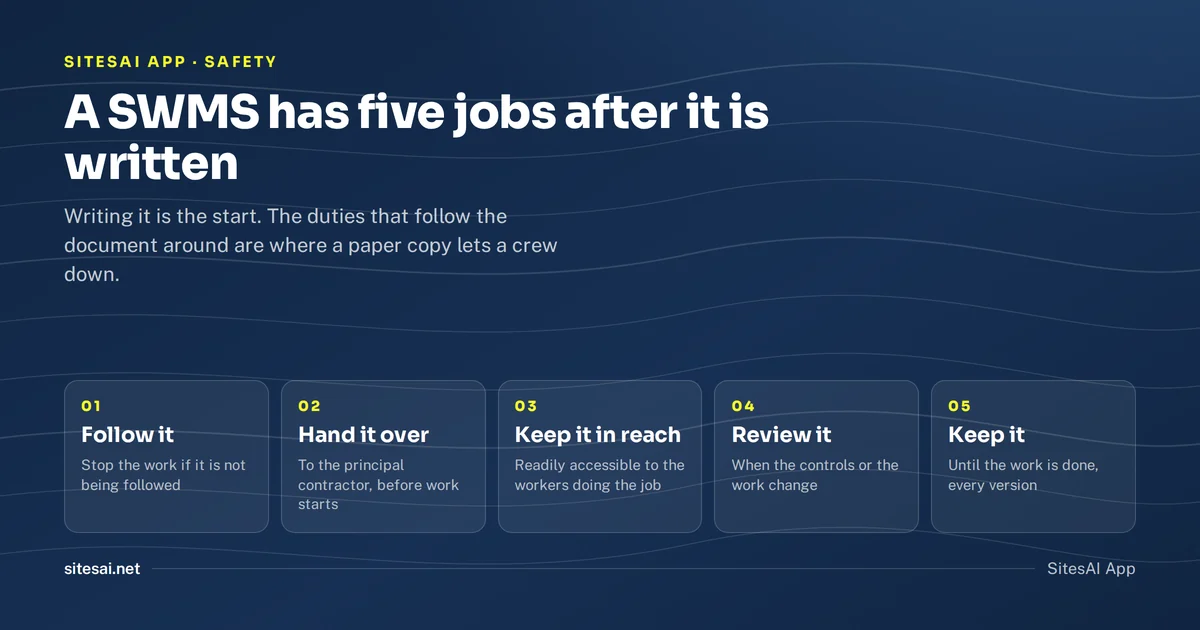
Five duties follow the document around, from Safe Work Australia's model Code of Practice for construction work:
- Follow it. High risk construction work must be carried out in accordance with the SWMS. If it is not, the work must stop immediately or as soon as it is safe to do so, and must not resume until it can be done in accordance with the SWMS.
- Give it to the principal contractor. On a construction project, a copy goes to the principal contractor before the work starts.
- Keep it within reach. For as long as it must be kept, the SWMS must be readily accessible and understandable to any worker engaged to carry out the work.
- Review it. If the control measures are revised, the SWMS must be reviewed and revised as necessary. WorkSafe Victoria says to review it whenever the work changes or there is an indication that risks are not adequately controlled.
- Keep it. Keep a copy until the high risk construction work is completed, or for at least two years after a notifiable incident connected with that work. Where a SWMS is revised, every version should be kept. In Victoria, the duty holder must retain a copy for the duration of the high-risk construction work.
What goes wrong with paper?
Paper fails in predictable places. The signed copy is in the ute, not at the trench. The version in the folder was written at tender, before anyone walked the site. The work changes on Wednesday, with a deeper excavation or a second machine in the pit, and the document does not. Six weeks later nobody can show which version the crew was working to.
Those are distribution and record-keeping problems, which is the part a phone is good at.
How do you run a SWMS digitally?
- Write it for this job, on this site. Walk the site with the crew who will do the work and change your template to match. Record who was consulted and when.
- Store one current version where the crew can open it, on the phone they already carry.
- Brief it before the work starts, at a toolbox talk, with each worker's name recorded against the date.
- Send it to the principal contractor before you start.
- Revise it when the work changes. Tell the crew, and keep the old version instead of overwriting it.
- Keep every version until the work is finished, and for at least two years if there is a notifiable incident.
Where does the SitesAI App fit?
The SitesAI App does not write a SWMS, has no template library, and does not judge whether yours is adequate. What it does:
- SWMS is a document type in the app's document wallet, alongside licences, insurances and white cards. A site can list the documents it requires from a company or from each member, and each submission is accepted or rejected with a note.
- Approved versions are locked. An update is a renewal: a new version goes out and the version you approved stays in your archive.
- Guided flows walk a worker through a start-of-day procedure on their phone, with photos and sign-offs captured as they go.
There is more on the site compliance feature page and in Guided Flows: the SOP your crew actually follows. The companion guide is Daily pre-start checklists for plant.
Sources, checked 2 October 2026
- Safe Work Australia, Safe work method statement for high risk construction work: information sheet
- Safe Work Australia, Model Code of Practice: Construction work, November 2024
- Safe Work Australia, High risk construction work requiring a SWMS
- WorkSafe Victoria, Safe Work Method Statements (SWMS)
Questions people ask
Does a SWMS have to be on paper?
No. Safe Work Australia says a SWMS can also be kept electronically, and WorkSafe Victoria says copies can be kept in electronic format. What matters is that the people doing the work can get to it where they are working.
How long do you have to keep a SWMS?
Under the model WHS Regulations, until the high risk construction work is completed, or for at least two years after a notifiable incident connected with that work. In Victoria the duty holder must retain a copy for the duration of the high-risk construction work.
Can one generic SWMS cover every job?
Safe Work Australia says a generic SWMS used at different workplaces may not meet the requirements of the WHS laws unless it has first been reviewed for the hazards and risks at the specific workplace and amended as necessary.
Is a SWMS the same as a JSA?
No. WorkSafe Victoria says a SWMS is not the same as a risk assessment or a job safety analysis. A SWMS is required under legislation to perform high-risk construction work. A JSA is not, although it can be a useful tool.
Run the job from one app — free up to 10 licences.
Leads, jobs, shifts, dockets, inductions and SOP flows for a small civil crew, on web, iOS and Android. What the SitesAI App does.