
Guides Running the job Plant
Daily pre-start checklists for plant: what to check and record
What a daily pre-start on an excavator, loader or truck should cover, what the regulators say about inspecting plant, and how to record it.
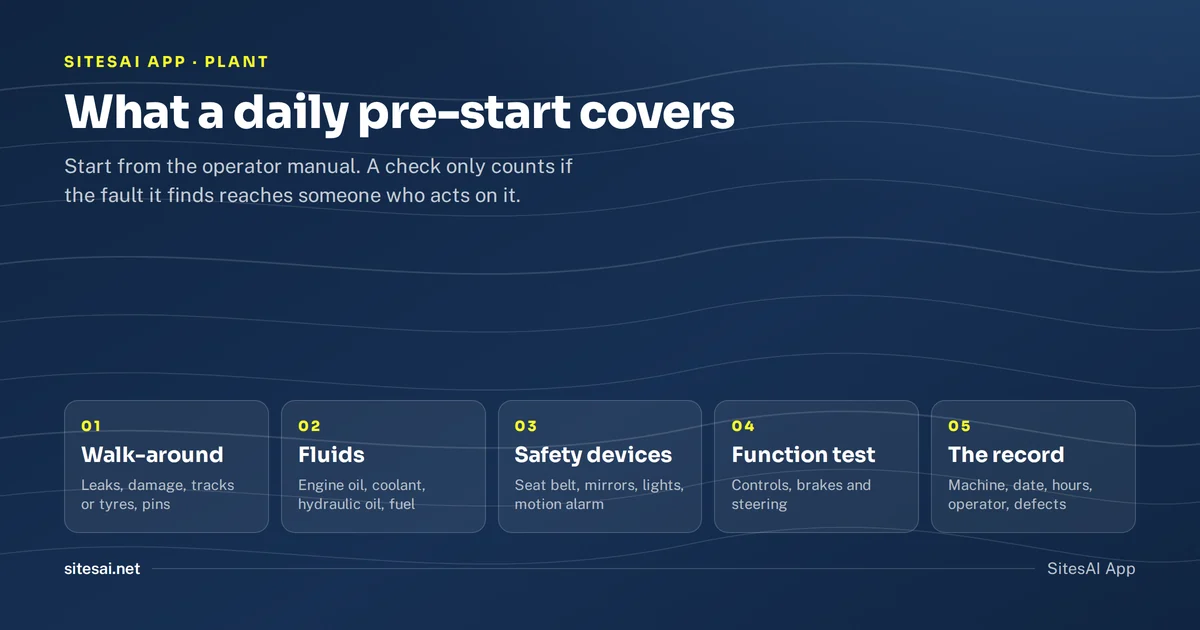
A daily pre-start is a short inspection the operator does before the machine works: a walk-around, the fluid levels, the safety devices and a test of the controls and brakes, written down with the machine, the date, the hour-meter reading and the operator's name. What goes on the list comes from the manufacturer's operator manual. And a check that finds a fault only counts if somebody then acts on it.
WorkSafe Victoria published a safety alert after an employee was hit and injured by a reversing excavator. The excavator had a motion alarm. It had been switched off with a switch in the cab.
This guide is general information for Australian civil and earthmoving crews. It is not legal advice. The regulators' documents are linked at the end.
Is a daily pre-start a legal requirement?
The regulations do not hand you a daily checklist, but they put the duty to inspect on you. Under model WHS Regulation 213, the person with management or control of plant at a workplace must ensure that maintenance, inspection and, if necessary, testing of the plant is carried out by a competent person. It must follow the manufacturer's recommendations if there are any. If there are none, it must follow the recommendations of a competent person. If neither is reasonably practicable, inspection must happen annually.
So the question for any machine is what its manufacturer says about inspection before use. If the operator manual sets out a daily inspection, that inspection is the manufacturer's recommendation.
WorkSafe Victoria is direct about it: "Employers should ensure pre-start checks of powered mobile plant are undertaken by operators in accordance with manufacturers' instructions."
What should a pre-start cover?
Start from the operator manual for that make and model. The list below is a common shape for an excavator, a loader or a tipper, not a substitute for the manual.
- Walk-around. Leaks under the machine, damage, loose or missing parts, tracks or tyres, pins, attachments and the quick hitch.
- Fluids. Engine oil, coolant, hydraulic oil and fuel.
- Safety devices. Seat belt, mirrors and cameras, lights, horn, the motion alarm and the guards. Safe Work Australia's code says guards and warning devices must be regularly inspected and tested to make sure they remain effective.
- Function test. Controls, brakes and steering.
- The readings. Hour meter and fuel level.
Keep it short enough to do properly every day.
What happens when the check finds a fault?
A pre-start that records the same cracked mirror every morning for a month is a record that you knew.
Safe Work Australia's code says plant with damage that poses a risk to health and safety should be withdrawn from service until those risks have been controlled. WorkSafe Victoria's compliance code says plant that presents an immediate risk needs to be rendered inoperable and tagged out until the risk is controlled, the plant is repaired, or it is decommissioned and removed. On warning devices, WorkSafe Victoria says that if they are faulty, the powered mobile plant should be removed from service until the device is repaired or replaced.
In practice, write three decisions into the checklist itself: which faults stop the machine, who gets told, and who signs it back into service.
How should you record a pre-start?
The record-keeping duty in the regulations is written for particular plant. Under model WHS Regulation 237, the person with management or control of plant that is required to be registered must keep a record of all tests, inspections and maintenance for the period the plant is used, or until they give up control of it. In Victoria the duty covers certain categories of plant, such as tower cranes and mobile cranes with a rated capacity above 10 tonnes.
Both regulators then give the same advice for everything else: it is good practice to keep records for other types of plant.
A pre-start record that is useful later has:
- the machine, by unit number or serial number
- the date, the time and the site
- the operator's name and signature
- the hour-meter reading
- each defect described in words, with a photo
- what was done about each defect, and by whom.
Paper can hold all of that. The test is whether you can use it: can you produce last Tuesday's pre-start for one machine in a minute, and did the defect reach someone who could act on it?
Where does the SitesAI App fit?
The SitesAI App does not supply a checklist for your machine and does not decide whether a machine is safe to use. It has no template library, so the checklist is yours, written from the manual. What it does:
- Each machine has its own pre-start checklist in the asset register, submitted by the worker before they use the machine.
- A tag opens it. Tapping the QR or NFC tag on a machine opens that unit's pre-start.
- The log records the machine, who did it, when, the meter reading, the fuel, the site, notes, a photo and a signature.
- A defect raises a task. A defect line on a pre-start raises a triage task, so the fault does not stay on the checklist.
- Services sit on the same record: intervals by machine hours and a maintenance history.
A pre-start can also be one step in a guided flow. See the equipment, pre-starts and maintenance feature page and Guided Flows: the SOP your crew actually follows. Work in an area where powered mobile plant is moving is also high risk construction work, which is covered in How to run SWMS digitally.
Sources, checked 2 October 2026
- Safe Work Australia, Model Code of Practice: Managing the risks of plant in the workplace, November 2024
- WorkSafe Victoria, Warning devices on powered mobile plant, safety alert
- WorkSafe Victoria, Compliance code: Plant
- Safe Work Australia, High risk construction work requiring a SWMS
Questions people ask
Is a daily pre-start check a legal requirement?
The regulations do not hand you a daily checklist. Model WHS Regulation 213 requires inspection of plant to follow the manufacturer's recommendations, and WorkSafe Victoria says employers should ensure operators do pre-start checks of powered mobile plant in accordance with manufacturers' instructions.
Who should do the pre-start?
The operator, before the machine works. WorkSafe Victoria's wording is that pre-start checks of powered mobile plant are undertaken by operators in accordance with manufacturers' instructions.
How long should pre-start records be kept?
For plant that must be registered, model WHS Regulation 237 requires inspection and maintenance records for as long as the plant is used or until you give up control of it. For other plant, Safe Work Australia and WorkSafe Victoria both call keeping records good practice.
What if the machine fails its pre-start?
Safe Work Australia's code says plant with damage that poses a risk to health and safety should be withdrawn from service until the risk has been controlled. Decide in advance which faults stop the machine and who signs it back into service.
Run the job from one app — free up to 10 licences.
Leads, jobs, shifts, dockets, inductions and SOP flows for a small civil crew, on web, iOS and Android. What the SitesAI App does.