
Guides Running the job How-to
The site diary: what to record daily, and why it pays
What belongs in a civil site diary, why weather and standing time are worth money later, and how to keep one on a phone without it becoming a second job.
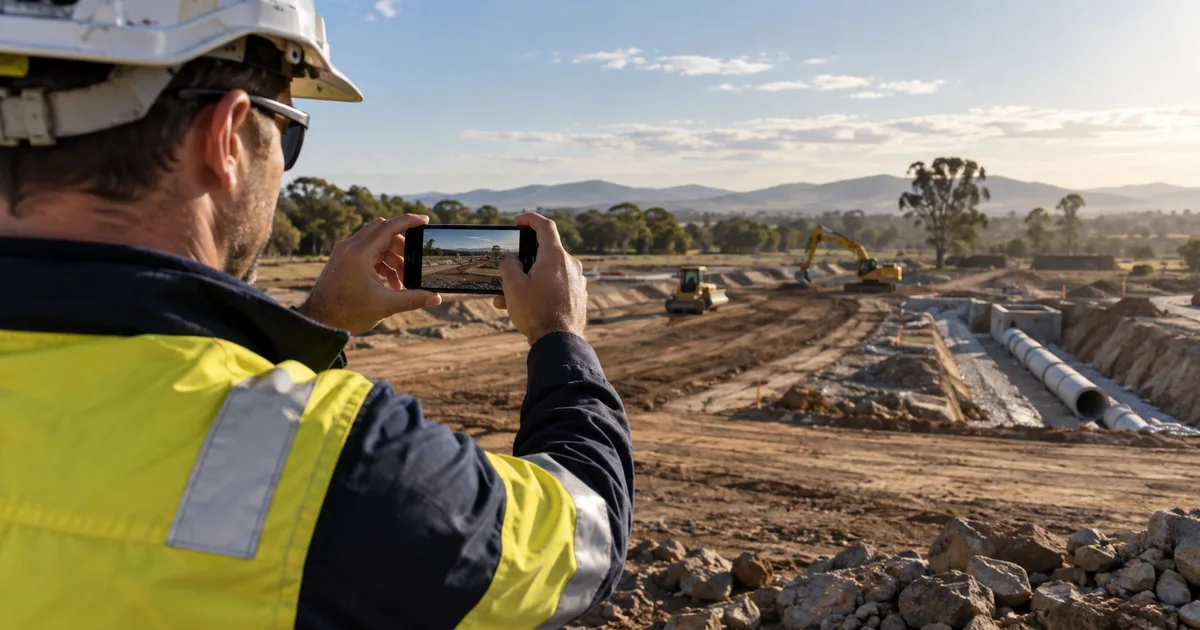
Ask ten civil contractors for their site diary and you will get three spiral notebooks, four camera rolls, two spreadsheets and one very confident memory. Then a claim comes in about a delay in August and all ten of them spend an evening trying to reconstruct a Tuesday.
A site diary is not paperwork for its own sake. It is the record you reach for when somebody disputes time, scope or damage — and those are the three things people dispute.
What belongs in a daily site diary entry?
Keep it to what you would need to defend a claim. That is a shorter list than most templates suggest.
Weather, properly. Not "wet". Note when it started, when you stopped, and what you could not do. "Rain from 11:20, stripping stopped, crew stood down 12:00" is worth money in an extension-of-time claim. "Wet day" is worth nothing.
Who was on site. Your people, subcontractors, and anyone else — the surveyor, the service locator, the client's engineer. If your timesheets already capture your crew, the diary only needs the others.
What plant was there, and what it did. Especially plant that was there and did not work. Standing time is a real cost and it is only claimable if it is recorded on the day.
What actually got done. In quantities where you can: "kerb poured, chainage 40 to 95", not "kerb work". The diary is also what you will reconcile the progress claim against.
Anything that stopped or slowed the work. Late delivery, a service not located, a design query waiting on an answer, an unexpected ground condition. Note the time you became aware and who you told. Delay claims live or die on the date you raised it, not the date it hurt.
Instructions and verbal directions. The site engineer asking for something different over the bonnet of a ute is a variation. Write down who said what and when, that day, before it becomes two people's recollections.
Photos. Before you start, when something is unexpected, and when work is covered up. The photo of the trench before backfill is the one you will want.
Safety. Incidents, near misses, toolbox talks, and anyone sent off site. This is also the record a regulator asks for.
Why does the weather line earn its keep?
Most small civil businesses under-claim wet weather because they cannot prove it. A bureau rainfall figure for the suburb is not evidence that your site was unworkable; a dated entry saying work stopped at 11:20, with a photo of standing water on the pad and the crew stood down at noon, is.
Over a wet winter that difference is weeks. Weeks are liquidated damages or an extension of time, and which one you get often comes down to whether anybody wrote anything down in August.
How do you keep a site diary without it becoming a second job?
The reason diaries fail is not that people do not understand them. It is that the diary lives somewhere other than where the work is recorded, so it is always extra.
What works:
- Record it where the job already is. Notes, photos and voice notes attach to the job, the site or the task itself. When the entry is a by-product of the work, it gets made.
- Let the phone do the metadata. Date, time and location come free. Stop typing them.
- Use voice notes when hands are dirty. Thirty seconds spoken into a phone beats a paragraph nobody typed. A transcript makes it searchable.
- Photograph, then say one line. The line is what makes the photo findable in November.
- Make it part of knock-off, not a Friday task. Friday diaries are reconstructions.
In the SitesAI App the diary is not a separate module for exactly this reason — comments, photos, files and voice notes attach to any record, and the activity log and company log book keep the running history. Clock-in already carries start and finish photos, geolocation and signatures, so the crew half of the diary writes itself.
What good looks like
A useful entry is short and specific:
Tue 16 Sep, Lot 12 Riverside. Rain from 11:20, stripping stopped, crew stood down 12:00, resumed 14:30. Excavator standing 11:20–14:30. Stripping complete chainage 0–120, topsoil stockpiled NE corner. Service locator on site 08:00–09:15, marked telecom not shown on plan through the northern pad — photo attached, notified J. Reid 09:30 by phone. Toolbox: exclusion zones around the locator.
Two minutes to write. In a dispute six months later it answers a standing-time claim, a wet-weather claim, a latent-condition claim and a notification question, and it has the photo.
Start with one site
Pick the job most likely to end in an argument and keep the diary properly on that one for a month. You will know very quickly whether it earns its two minutes — in our experience the first disputed day pays for the year.
The SitesAI App is free up to ten licences, where a licence is one active team member or one active site. Sign in with Google, Microsoft or Apple at app.sitesai.net, or see Running a small civil crew from one app.
Questions people ask
How long should a diary entry take?
Two minutes. If it takes ten, nobody will do it by Thursday and you will have a fortnight of blanks when it matters.
Is a photo enough on its own?
Almost. A photo with a date, a location and one line of context is worth more than a paragraph without one. A photo with no note is evidence of something nobody can identify six months later.
Who should write it?
Whoever is on site. A supervisor writing it from the office on Friday is a work of fiction, and it reads like one in a dispute.
Does a diary help with a variation claim?
It is often the only thing that does. A variation argued from memory is a negotiation; a variation argued from dated entries and photos is a calculation.
Run the job from one app — free up to 10 licences.
Leads, jobs, shifts, dockets, inductions and SOP flows for a small civil crew, on web, iOS and Android. What the SitesAI App does.