
Guides Earthworks takeoff Explainer
What is cut and fill? Meaning, balance and batters
Cut and fill in plain English: what cut and fill mean in construction, cut to fill vs cut to spoil, site balance, batters, and how the volumes are measured.
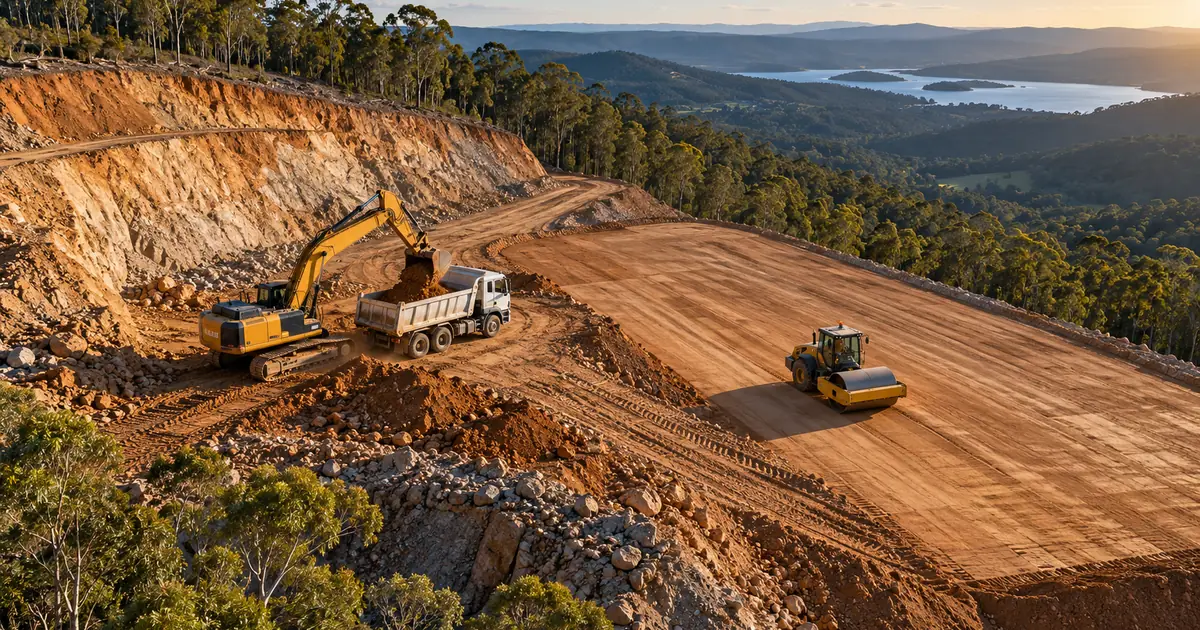
Cut and fill is the earthworks that bring the ground to a design level. Where the ground is too high, you dig it out: that is cut. Where it is too low, you place and compact material: that is fill. Wherever you can, the cut becomes the fill, so less material is trucked in or out.
Almost every civil job has it: a house pad on a sloping block, a subdivision road, a car park, a dam wall or a drainage channel. The cut and fill volumes decide how long the machines are on site, how many trucks you need, and whether the job pays tip fees or buys in fill.
Cut and fill in construction
Picture a flat building pad set into a hillside. On the uphill side the existing ground sits above the pad level, so it is cut. On the downhill side the ground sits below it, so it is filled. In between is the cut/fill line, where the existing ground is already at the design level and nothing changes.
On a plan, a cut and fill drawing (a cut/fill map) usually shades the two areas in different colours, with depth contours or spot depths across each. Positive numbers are cut and negative numbers are fill.
Cut to fill, cut to spoil and import
Where the material goes matters more to the price than the volume does:
- Cut to fill: the cut is suitable and is reused as fill on the same site. This is the cheapest earthworks there is.
- Cut to spoil: the cut is surplus, or unsuitable (topsoil, wet clay, contaminated soil), and is carted away. You pay for the trucks and usually a tip fee.
- Import (borrow): the site is short and needs fill brought in, often a specified material for structural fill.
A site that needs no import and no cart-away is balanced. Designers often set a pad or road level so the site balances, because every cubic metre that does not leave site is one nobody pays to haul.
Why a balanced site has more cut than fill
Soil changes volume as it is moved:
- In the ground it is bank volume.
- Dug and in the truck it is loose volume. It is bigger, because air gets in. The ratio is the swell factor, typically about 1.2 to 1.4 for clays and soils.
- Placed and rolled in the fill it is compacted volume. For soils this is usually smaller than bank. The ratio is the shrink factor, typically about 0.85 to 0.95.
So 100 m³ of clay fill needs roughly 100 ÷ 0.90 = 111 m³ of clay cut. A balanced site looks long on paper. The full table by material is in soil bulking and shrinkage factors.
Cut batters and fill batters
Earthworks rarely stop at a vertical edge. A batter is the sloping face around a pad, road or dam:
- A cut batter is dug back into the ground on the high side.
- A fill batter is the sloping edge of the placed fill on the low side.
Batters add volume outside the pad, and on a steep block they can add more than the pad itself. How steep a batter can be depends on the soil, its height and the site. For houses, the National Construction Code housing provisions set maximum slopes for unprotected embankments by soil type. On larger jobs the geotechnical engineer sets them. Where there is no room for a batter, a retaining wall takes its place, and that is a separate cost.
Cut and fill on roads
On a road or rail line, the alignment runs through high and low ground, so the cut from one stretch fills the next. Estimators plot a mass haul diagram to see how far material travels and where cut to spoil or import is cheaper than a long haul along the job.
You will also see "cut and fill" in underground mining. There it is the name of a stoping method that backfills mined-out voids. It is unrelated to earthworks takeoff.
How cut and fill is measured
Every method compares the existing surface with the design surface:
- Grid method: levels on a regular grid, and volume worked out cell by cell. Best for pads and building sites.
- Cross-sections: cut and fill areas at regular chainages, and volume by the average end area. Best for roads, drains and channels.
- Surface comparison: software builds both surfaces from every contour, spot level and design line, then measures between them. This is what takeoff software does.
For a worked example of each by hand, see how to calculate cut and fill. For a quick answer from your own levels, use the free cut and fill calculator. For a whole site from the plan, SitesAI Estimate builds the surfaces from your PDF, DWG or DXF plan, adds batters, shows the job in 3D and turns the volumes into a priced estimate.
Questions people ask
What does cut and fill mean?
Cut is ground dug out because it sits above the design level. Fill is material placed and compacted where the ground sits below it. Cut and fill together are the earthworks that turn the existing ground into the design shape.
What is the difference between cut to fill and cut to spoil?
Cut to fill is cut reused as fill on the same site. Cut to spoil is cut that cannot be used, or is not needed, and is carted away to a tip or another site. Cut to fill is usually much cheaper, because nothing pays a tip fee or a long haul.
What is a balanced cut and fill?
A site balances when the cut, once compacted, makes exactly the fill, so nothing is imported or carted away. Because compacted soil takes less room than it did in the ground, a balanced site has more cut than fill on paper.
What is a cut batter and a fill batter?
A batter is the sloping face at the edge of earthworks. A cut batter is the slope dug into the ground on the high side of a pad or road. A fill batter is the slope of placed fill on the low side. Both add volume outside the pad itself.
Try it on your next plan set — free.
Sign in with Google or Microsoft, add a PDF or DWG/DXF, and see cut and fill in minutes. Pro is US$39 per user per month, the AI plan has a free 14-day trial; cancel any time. What SitesAI Estimate does.